A 17-year-old boy watched his father fall backward from a ladder and immediately knew he needed help. That quick decision may have saved his father’s life. John Peacock, a 42-year-old Alabama contractor, suffered a devastating brain injury on November 10, 2025, after falling while changing a lightbulb at a remodeling site. His son, JC, wasted no time calling 911.
John struck the back-left side of his head when he hit the floor. The accident happened while he was working on a home renovation project. JC called emergency services and then contacted his mother, Alaina Peacock. The family had no idea that a routine task would lead to months of hospital treatment and rehabilitation.
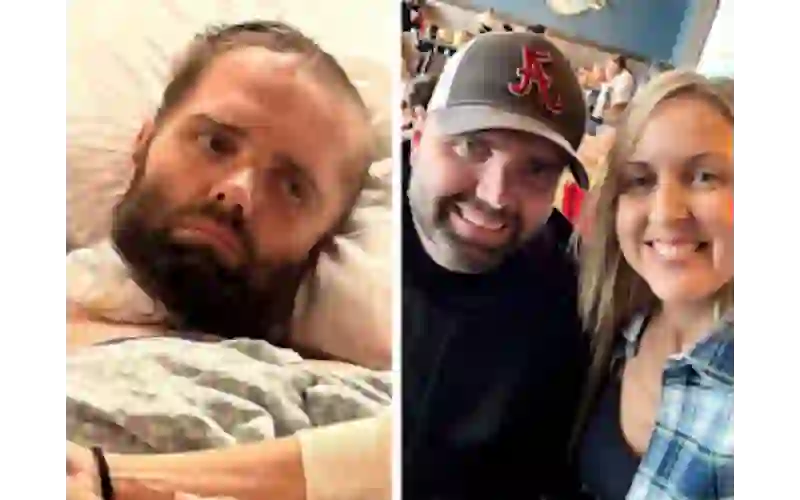
John was flown to Ascension Sacred Heart Hospital in Pensacola, Florida. His wife rushed to the hospital, where doctors gave her a frightening account of his condition. He had suffered strokes and multiple brain bleeds, and the swelling inside his head was so severe that surgeons had to remove part of his skull to relieve the pressure.
The situation was so serious that one doctor advised Alaina to prepare for the possibility that her husband might not survive. She was also warned that surviving the injury would not necessarily mean he could return to his former life. Nobody could tell her whether John would wake up or regain the ability to communicate.
JC’s actions had given his father a chance, but the family still faced an uncertain future. John remained in a coma, and the first 72 hours were especially important. Doctors watched him closely after surgery, while Alaina tried to process what had happened to the man she had built her life with.
John spent 15 days in intensive care. For the first week, there was little visible response when medical staff examined him. They tried different forms of stimulation, but he showed almost no movement. Then, on the eighth day, something changed. John opened one eye, blinked and began tracking movement.
It was a small development, but it meant a great deal to his family. After days of seeing almost no response, Alaina finally had a reason to believe that her husband was beginning to come around. Before leaving intensive care, John also started breathing on his own, another important step in his recovery.
On November 25, he was moved to Select Specialty Hospital for continued treatment. He was still unable to communicate properly and remained in a severely weakened condition. His family continued to wait for signs that his brain was recovering.
The next major move came on December 13, when John was transferred to Brooks Rehabilitation Hospital in Jacksonville. There, he rolled over in bed for the first time since his fall. He also began showing signs of recognizing familiar objects and understanding certain actions. His recovery was slow, but the changes offered a glimpse of what might still be possible.
John’s medical journey was not without another frightening setback. In January, surgeons attempted to reattach the part of his skull that had been removed. Doctors later discovered blood collecting inside his skull, forcing them to perform another emergency operation. After eight days of monitoring, he returned to Brooks Rehabilitation on January 30.
While John continued his fight, Alaina was also dealing with responsibilities back home. She was the head girls basketball coach at Alma Bryant High School, where the team had been preparing for its season. With her husband needing constant support, she handed the coaching role to assistant coach BJ Evans.
The team went on to reach the Class 7A Final Four in February, an achievement that came during one of the most difficult periods in the Peacock family’s life. John eventually left Brooks on February 20, 2026, after 102 days of treatment and rehabilitation. He returned home with Alaina as he continued working on his recovery.
His progress did not mean the medical journey was over. John still faced major challenges with speech, movement and everyday activities. In May, his family pursued further treatment, and by August, he had returned to Brooks for an eight-week individualized rehabilitation program.
Alaina said her husband was making progress, including producing words that he had struggled to say before. The family was also dealing with insurance difficulties and the emotional strain of spending so much time away from home. Their children had to stay with relatives while their parents focused on John’s treatment in Jacksonville.
For JC, the events of November 10 will always be significant. His quick call for help came at a moment when every second mattered. For the rest of the family, John’s continued progress has brought hope after months of fear and uncertainty. The man who once lay unresponsive in a hospital bed is still working to regain the abilities that most people use every day without thinking twice.
Leave a Reply